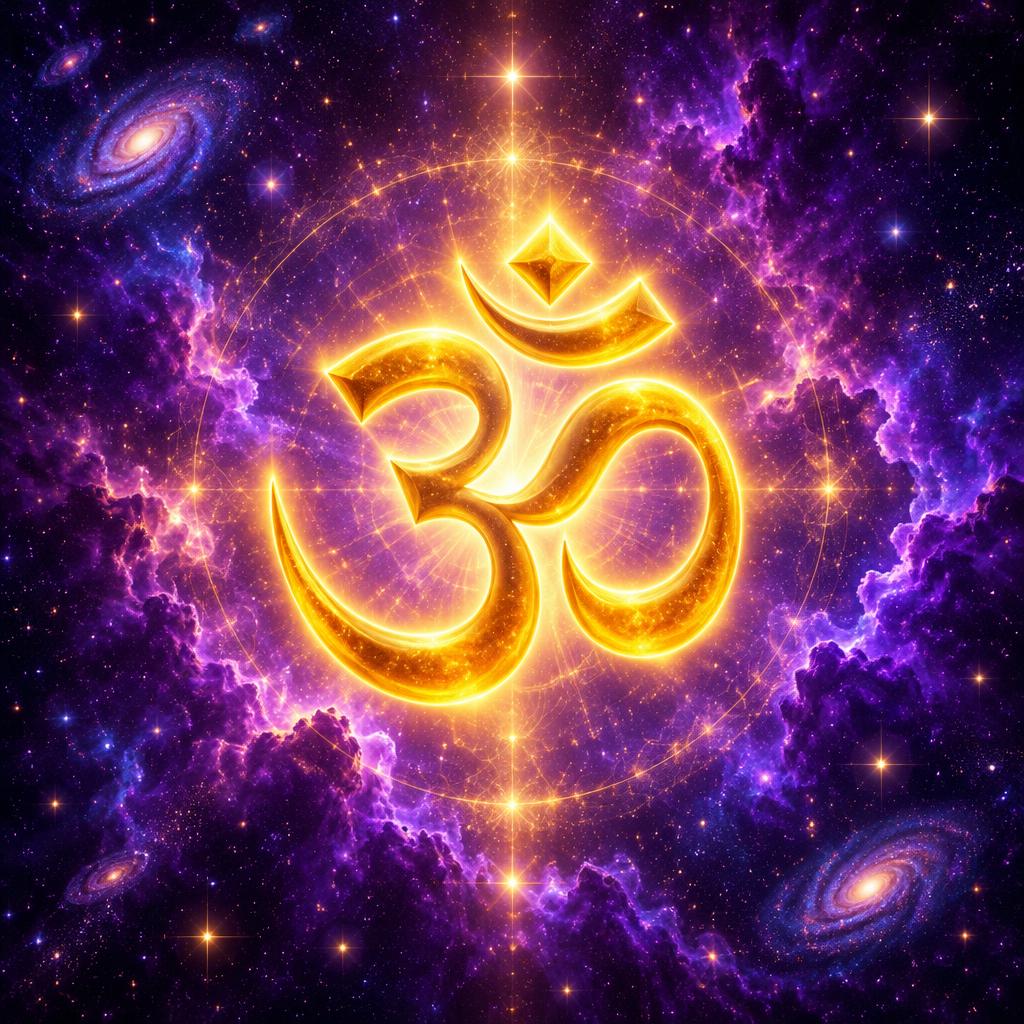
Of all the sounds a human voice can make, one has been chanted longer, more widely, and with more reverence than any other: Om. You have seen the symbol — perhaps on a temple, perhaps on a pendant — but Om is not a symbol to be looked at. It is a sound to be entered, and the Mandukya Upanishad devotes twelve short verses to unpacking it, claiming the entire universe lives inside this one syllable.
Why Om? Because it is less a word than a resonance. Say it slowly — the lips begin closed, the sound blooms through the throat and chest, and the final 'm' hums in the skull like a struck bell fading. Physicists have noted that the Om's drone resembles the deep hum of the universe itself — a cosmic background vibration, Oṁ as the ancients heard it all along.
A-U-M: the three states of consciousness
The Mandukya teaches that Om's three sounds map the three great states of consciousness, with a fourth hidden beyond them:
- A (pronounced 'ah') — the waking state, wide open to the outer world, the sound of beginning.
- U ('oo') — the dream state, turned inward, weaving inner worlds from impressions.
- M ('mm') — deep sleep, where all differentiation dissolves into undisturbed peace.
- The silence after the sound — turiya, the fourth: pure consciousness itself, the witness that was present through all three states.
This is why chanting Om is a complete meditation. As the sound rolls from A to M, it traverses waking, dreaming, and dissolution — and when the sound ends, the silence that remains is not absence but the presence that underlies everything. You have visited turiya every night without knowing it. Chanting Om is simply visiting on purpose.
Chanting Om
Sit tall and take a slow, full breath. Begin the sound at the back of the throat, let 'ah' open the chest, allow 'oo' to roll the resonance upward, and close with 'mm' held gently on the exhale. Let the final hum fade completely before the next breath — the silence between chants is half the practice.
Chant aloud three times, then let the sound grow quieter, then let it move inside as mental repetition. Seven repetitions make a lovely morning ritual; a mala round of 108 makes a profound one. You may feel it in the sternum, a warmth in the face, a settling of thought like sediment in stilling water. Do not chase the effects — chase the sound, and let the effects follow.
"The syllable Om is indeed the eternal word. Knowing it, one attains the goal of all striving."
Om in daily life
The ancients placed Om at the opening of every scripture because it sets the inner climate: a mind that has touched the primordial sound reads sacred words from the inside. You can keep this custom alive simply. Begin your meditation with three Oms. Open your journal with one. Let it be the sound your family hears before meals — short, unhurried, sincere.
In time, Om becomes a kind of home address for consciousness. However far the mind travels during the day — into work, into worry, into noise — one silent Om is the road back to the center. The Upanishad's final teaching is almost tender: the Self, the still point behind all states, is not other than you. Om is how we remember.